 Skip to content
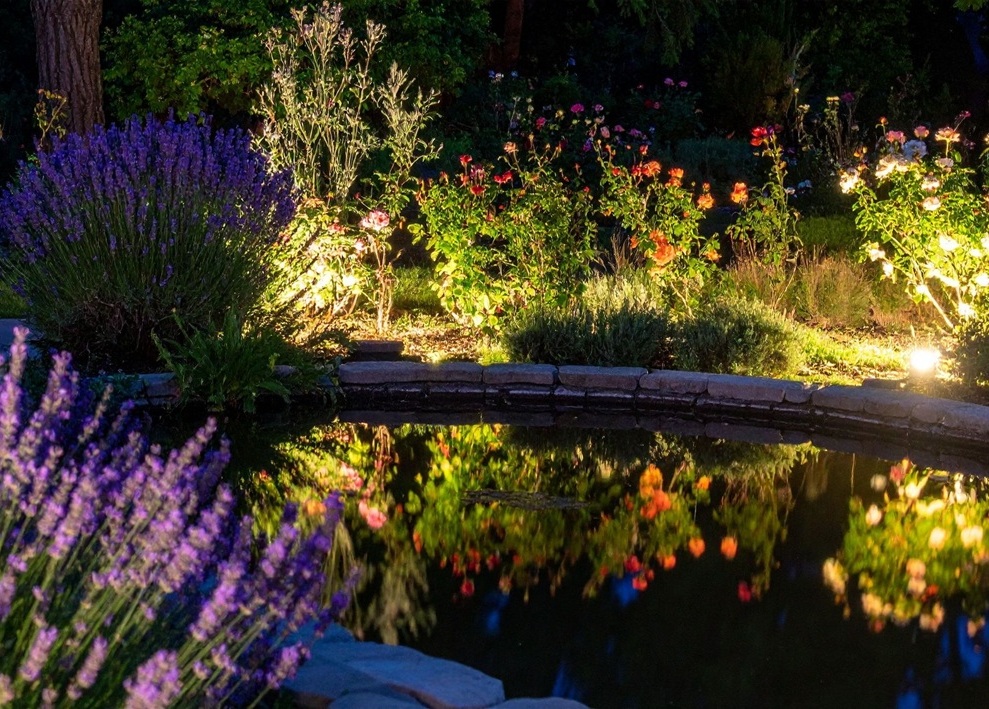
The biggest difference in solar vs low voltage landscape lighting is how each system gets its power. Solar landscape lights collect energy from sunlight during the day and store it in a built-in battery for use after dark. Low-voltage landscape lighting, by comparison, draws electricity from the home through a transformer that reduces the voltage before sending power to outdoor fixtures. This basic difference affects installation, placement, brightness, reliability, and maintenance. Solar lighting is generally more flexible because it does not require underground wiring, while low-voltage systems provide a more consistent power source and can support a coordinated network of fixtures throughout a property.
How Solar Landscape Lighting Works
A solar landscape lighting system typically includes a small solar panel or collector, a rechargeable battery, and an LED fixture. During daylight hours, the solar panel absorbs sunlight and converts it into energy that is stored in the battery. Once daylight fades, the stored energy powers the fixture. Because solar lights operate independently from household wiring, they can often be installed or repositioned more easily, provided the solar panel receives enough sunlight to recharge effectively.
How Low Voltage Landscape Lighting Works
Low-voltage landscape lighting uses electricity from the home rather than energy collected from the sun. The system connects to a transformer, which reduces the household electrical supply before sending power through low-voltage cables to landscape lighting fixtures. Multiple fixtures can then be connected along the same system to illuminate pathways, garden areas, architectural features, and larger outdoor spaces.
The Solar Vs Low Voltage Landscape Lighting Transformer is therefore an important part of the comparison. Unlike solar fixtures, which generate and store their own energy, low-voltage lights depend on a centralized transformer and cable network. This requires more planning during installation, but it also provides consistent power regardless of sunlight or weather conditions.

Solar vs Low Voltage Landscape Lighting Comparison
A Solar Vs Low Voltage Landscape Lighting Comparison comes down to several practical differences, including power source, installation, brightness, reliability, placement, and maintenance. Solar lighting uses sunlight collected during the day and stored in a battery, which makes it relatively easy to install without running electrical cables. Low-voltage lighting uses household electricity through a transformer and wired system, so installation requires more planning but delivers steadier performance.
Solar fixtures are often a good fit for decorative accents, garden borders, and locations where easy placement matters most. However, their brightness and runtime can vary depending on sun exposure, weather, and season. Low-voltage systems are generally better suited to areas where consistent illumination is important, including larger landscapes, pathways, and shaded spaces. They can provide stronger, more dependable light, but they also require cables, fixtures, and transformer maintenance.
Overall, neither option is universally better. The strongest choice depends on the layout of the property, available sunlight, lighting goals, and how much installation and maintenance the homeowner is comfortable with.
Brightness and Lighting Performance
Brightness is one of the most noticeable differences when comparing Solar Vs Low Voltage Landscape Lights. Solar fixtures are often better suited to softer, decorative lighting, while low-voltage systems typically provide stronger and more consistent illumination. The right choice depends on whether the goal is to create ambiance or provide dependable light across larger outdoor areas.
Solar Landscape Light Performance
Solar landscape lights can work well for decorative accents, garden beds, small paths, patio edges, and other areas where intense illumination is not essential. Their flexibility makes them useful for highlighting specific features without the need for wiring. However, their performance depends on how much sunlight the panel receives. Shade, seasonal changes, weather, and fixture placement can all affect how brightly and how long the lights operate at night.
Low Voltage Landscape Light Performance
Low-voltage lighting generally provides more consistent illumination because it does not depend on sunlight for power. These systems can deliver higher brightness and broader coverage, making them especially useful for larger landscapes, driveways, pathways, and areas where reliable nighttime visibility matters. When comparing Solar Lighting Vs Low Voltage Lighting, low voltage is typically the stronger option when consistent output and dependable performance are the main priorities.
Installation and Setup

Installation is another major difference in a Solar Vs Low Voltage Landscape Lighting System. Solar lighting is generally simpler to place because it does not require a wired connection to the home, while low-voltage lighting involves more planning around the transformer, cable routes, and fixture locations. The installation method can therefore influence both the initial project complexity and how easily the system can be adjusted later.
Installing Solar Landscape Lighting
Many solar landscape lights can be installed without underground electrical cable, making them relatively quick and easy to set up. Because each fixture operates independently, homeowners can often reposition the lights as landscaping changes or as different areas need more illumination. The main limitation is sunlight exposure. Solar fixtures need to be placed where their panels can collect enough daylight to recharge effectively. This makes sunny garden beds, walkways, and open landscape areas especially suitable locations.
Installing a Low Voltage Landscape Lighting System
Low-voltage installation requires more advance planning. The transformer must be positioned appropriately, cables need to be routed through the landscape, and fixtures must be placed where they can connect to the system. In some projects, cables may also need to be buried or concealed for a cleaner appearance. These additional steps make installation more involved than solar lighting, especially across larger properties. Any work involving mains electricity, outdoor circuits, or the transformer connection should be handled by a qualified professional.
Transformer and Wiring Requirements
The transformer and wiring setup is one of the clearest differences in a Solar Vs Low Voltage Landscape Lighting Transformer comparison. Low-voltage systems rely on a central power source and cable network, while solar fixtures typically operate as self-contained units. This difference affects installation complexity, placement, and how the lighting system is expanded over time.
What Does a Low Voltage Landscape Lighting Transformer Do?
A low-voltage landscape lighting transformer connects to the home’s electrical supply and reduces the voltage before sending power to outdoor fixtures. From there, low-voltage cables distribute electricity throughout the landscape to each connected light. This setup allows multiple fixtures to operate from the same system and helps provide consistent power across pathways, garden areas, and other outdoor spaces.
Do Solar Lights Need a Transformer?
Solar landscape lights generally do not require a centralized transformer. Each fixture typically includes its own solar panel and battery, allowing it to collect, store, and use energy independently. Because of this, solar lighting avoids the transformer-and-cable network used by low-voltage systems, which can make installation simpler and placement more flexible as long as the fixture receives enough sunlight.
Placement and Landscape Design Flexibility
Placement flexibility is an important consideration when comparing solar and low-voltage landscape lighting. Solar fixtures are easier to move because they do not rely on underground wiring, but they still need access to sufficient sunlight. Low-voltage fixtures require cable connections, yet they can often be installed in areas where solar lighting would struggle to recharge effectively.
Where Solar Landscape Lights Work Best
Solar landscape lights are best suited to locations with reliable sun exposure, such as sunny garden beds, walkways, landscape borders, and freestanding decorative areas. They can also be useful in locations where running cable would be inconvenient or disruptive. Because solar fixtures operate independently, they can usually be repositioned more easily as landscaping changes, provided the solar panel continues to receive enough daylight.
Where Low Voltage Landscape Lights Work Best
Low-voltage lighting is often the better fit for shaded areas, locations under trees, spaces near structures, driveways, larger pathways, and architectural lighting applications. Unlike solar fixtures, low-voltage lights do not depend on direct sun exposure, so they can provide reliable illumination wherever the cable can reach. This makes them especially useful for larger or more coordinated landscape lighting designs where consistent placement and coverage are priorities.
Reliability in Shade, Weather and Different Seasons
Reliability is one of the most important differences between solar and low-voltage landscape lighting, especially in areas with heavy shade or noticeable seasonal changes. Solar fixtures depend on daylight to recharge, so their performance can vary throughout the year. Low-voltage systems, by comparison, draw steady power from the home and are generally less affected by changing weather or sunlight conditions.
How Sun Exposure Affects Solar Landscape Lights
Solar landscape lights perform best when their panels receive enough daylight to fully recharge. Shaded locations can reduce charging opportunities, while shorter winter days may lead to shorter runtimes or lower light output. Weather and fixture placement can also influence performance, particularly if trees, structures, leaves, dirt, or other obstructions block the solar panel. Keeping the panel clean and positioned where it can receive adequate sunlight helps support more reliable operation.
Why Low Voltage Lighting Is More Consistent
Low-voltage landscape lighting does not rely on daylight charging, which gives it a major advantage in areas where consistent illumination is important. Once properly installed, the system can provide steady output in shaded areas, during cloudy weather, and throughout different seasons. This makes low-voltage lighting especially useful for pathways, entrances, and larger landscape areas that need predictable nighttime visibility year-round.
Maintenance and Long-Term Durability

Maintenance is another important factor when comparing Solar Vs Low Voltage Landscape Lighting Fixtures. Both systems require some ongoing care, but the type of maintenance differs. Solar fixtures depend on batteries and exposed solar panels, while low-voltage systems require attention to fixtures, wiring connections, and the transformer.
Maintaining Solar Landscape Lighting Fixtures
Solar landscape lights typically need their panels kept clean so dirt, leaves, or debris do not reduce the amount of sunlight they can collect. Battery performance should also be monitored over time, since rechargeable batteries gradually lose capacity and may need replacement when the fixture allows it. The solar panel and other exposed components should also be checked for damage, especially after severe weather or heavy landscape maintenance. Battery degradation and panel cleaning as recurring maintenance considerations for solar lighting.
Maintaining Low Voltage Landscape Lighting Fixtures
Low-voltage landscape lighting requires a different type of upkeep. Fixtures should be inspected periodically, cable connections should remain secure, and the transformer should be checked as part of the overall system. As plants and trees grow, fixtures may also need to be repositioned so the intended lighting effect is not blocked. Because low-voltage systems rely on connected components, maintaining the wiring, fixtures, and transformer together helps support reliable long-term performance.
Energy Use and Operating Costs
Energy use is another clear point of difference between solar and low-voltage landscape lighting. Solar fixtures operate using energy collected from sunlight, while low-voltage systems still rely on electricity from the home. The actual operating cost of either system will vary based on the number of fixtures, wattage, runtime, and the specific products being used, so it is better to compare the general energy requirements rather than assume one fixed cost.
Solar Landscape Lighting Energy Costs
Solar landscape lights do not draw their operating power from the household electrical supply. Instead, their panels collect sunlight during the day and store that energy in an internal battery for use at night. This allows them to operate without adding direct electricity usage to the home’s power consumption.
Low Voltage Landscape Lighting Energy Costs
Low-voltage landscape lighting still uses electricity from the grid, although the amount can be relatively modest depending on the fixtures and overall system design. The transformer reduces the voltage before power is distributed through the lighting system, but the electricity ultimately still comes from the home. Arbor Hills makes this distinction directly, noting that low-voltage lighting uses grid electricity while solar lighting does not rely on the household energy supply.
Solar vs Low Voltage Landscape Lighting Cost
The cost of Solar Vs Low Voltage Landscape Lighting depends on more than the price of the fixtures alone. Homeowners should consider both the upfront purchase and installation costs as well as the long-term operating requirements. Solar lighting can be simpler to install because it does not require a transformer or extensive wiring, while low-voltage systems may involve more equipment and labor. However, the final cost varies widely based on the size of the project, fixture quality, and site conditions.
Solar Lighting Costs
Solar lighting costs are influenced by the number of fixtures, solar panel quality, battery quality, fixture construction, brightness, and weather resistance. Higher-quality solar products may cost more upfront, especially if they use more durable materials or stronger batteries. Because solar fixtures are generally self-contained, they can reduce the need for wiring and installation work, but total cost still depends on how many lights are needed and the level of performance required.
Low Voltage Lighting Costs
Low-voltage landscape lighting typically includes the cost of fixtures, a transformer, wiring, connectors, and installation labor. Larger or more complex landscapes may require longer cable runs, additional fixtures, and more installation work, which can increase the total project cost. Rather than assuming one system is always cheaper, it is more accurate to compare the full project scope, since product prices, availability, and installation conditions can vary by location and property.
Solar vs Low Voltage Landscape Lighting Fixtures
The choice between Solar Vs Low Voltage Landscape Lighting Fixtures is not limited to power source alone. Both systems are available in different fixture styles designed for specific landscape applications, from pathways and garden beds to architectural features and water elements. The best fixture depends on what needs to be illuminated and how much light the area requires.
Path Lights
Path lights are commonly used along walkways, entrances, and garden borders. Solar versions can work well in open areas with good sun exposure, while low-voltage path lights may be better suited to locations where more consistent illumination is needed.
Spotlights and Accent Lights
Spotlights and accent lights are used to highlight trees, plants, sculptures, and architectural details. These applications often benefit from more focused light output, making low-voltage fixtures a strong option when brightness and consistency are priorities.
Garden and Decorative Lights
Garden and decorative fixtures are often well suited to solar lighting, especially when the goal is to create softer visual accents rather than illuminate a large area. The source material similarly describes solar lighting as useful for decorative areas and smaller landscape applications.
Specialty Landscape Lighting
Specialty fixtures can also be used around ponds, water features, and other designed landscape elements. The third source shows both solar and electrically powered lighting options being used for pond and water-feature applications, illustrating how either system can be adapted to more specialized outdoor settings.
Best Solar vs Low Voltage Landscape Lighting Options by Application

The Best Solar Low Voltage Landscape Lighting choice depends heavily on where the fixtures will be used and what the homeowner wants the lighting to accomplish. Rather than choosing one system for an entire property, it can be more effective to match different Solar Vs Low Voltage Landscape Lighting Options to specific areas and lighting goals.
Best Option for Small Gardens
Solar lighting can be a practical choice for smaller gardens, decorative planting areas, small patios, and path borders. In these spaces, homeowners may not need intense or highly coordinated illumination, making the flexibility and simple installation of solar fixtures especially useful.
Best Option for Large Landscapes
Low-voltage lighting is often better suited to larger properties where broader coverage, stronger brightness, and consistent performance are important. A wired system can support multiple coordinated fixtures across pathways, driveways, garden zones, and other outdoor areas. The source material specifically notes that low-voltage lighting becomes more beneficial in larger gardens that require greater coverage and brightness.
Best Option for Shaded Landscapes
Low-voltage lighting is generally the stronger option in heavily shaded areas because it does not depend on sunlight to recharge. This can make it more reliable beneath trees, near structures, or in parts of the landscape that receive limited daylight.
Best Option for Decorative Accent Lighting
Solar lighting can be especially effective for decorative accents where portability and easy placement matter more than maximum brightness. Garden borders, ornamental planting areas, and other visual features can often benefit from softer solar lighting without requiring additional wiring.
Can You Use Solar and Low Voltage Landscape Lighting Together?
Yes. Homeowners do not necessarily have to choose only one system. In many landscapes, combining solar and low-voltage lighting can provide a more practical balance between flexibility and consistent performance. A mixed design allows each lighting type to be used where it performs best rather than forcing one solution across the entire property.
When a Hybrid Landscape Lighting Design Makes Sense
A hybrid landscape lighting design can work especially well when different parts of the property have different needs. Low-voltage lighting can be used along primary walkways, driveways, architectural features, and shaded areas where dependable illumination is important. Solar fixtures can then be added to decorative garden areas, borders, or locations where wiring would be inconvenient or where the layout may change over time.
Using both can help homeowners take advantage of solar lighting’s easy placement while still getting the reliability and stronger coverage of a low-voltage system where it matters most.
How to Choose High Quality Solar or Low Voltage Landscape Lighting
Choosing High Quality Solar Low Voltage Landscape Lighting requires looking beyond appearance alone. Fixture construction, light output, weather resistance, maintenance needs, and overall system design can all influence how well the lighting performs over time.
Look at Fixture Construction
Outdoor lighting should be designed for exterior use and built from materials suited to the conditions where it will be installed. Construction quality matters because fixtures are exposed to moisture, dirt, landscaping activity, and changing weather throughout the year.
Consider Light Output and Beam Pattern
Choose fixtures based on what you want to illuminate. A path light, accent light, and architectural spotlight have very different purposes, so brightness and beam direction should match the application rather than simply the fixture’s appearance.
Evaluate Weather Resistance
Consider how much exposure the fixture will have to rain, irrigation, debris, and seasonal weather. More exposed areas may require more durable outdoor-rated fixtures.
Consider Replaceable Components
For solar lights, battery serviceability can affect long-term usefulness because rechargeable batteries degrade over time. For low-voltage systems, homeowners should consider fixture compatibility, transformer requirements, and whether the system can accommodate future expansion.
Design the System Before Buying Fixtures
Before selecting fixtures, determine which areas need illumination, where shade may limit solar charging, where consistent brightness is important, and which spaces are primarily decorative.
Common Solar and Low Voltage Landscape Lighting Mistakes

Many landscape lighting problems begin with choosing fixtures before considering the property itself. One common mistake is installing solar lights in heavily shaded areas where the panels cannot receive enough daylight to recharge effectively. Homeowners may also assume solar lighting will perform exactly the same throughout the year, even though shorter days, weather, and placement can affect output.
Maintenance can also be overlooked. Solar panels need to remain clean, and batteries can lose capacity over time. With low-voltage lighting, homeowners may underestimate the importance of cable routing or assume wired fixtures will be as easy to relocate as independent solar lights.
Another practical mistake is expecting small decorative solar fixtures to provide the same broad, consistent illumination as a larger low-voltage system.
Solar Vs Low Voltage Landscape Light: Which Is Better?
There is no single answer to whether a Solar Vs Low Voltage Landscape Light is better. The strongest choice depends on the property, available sunlight, desired brightness, installation preferences, and the role the lighting needs to serve.
Choose Solar Landscape Lighting If…
Solar lighting makes sense when easy installation and flexible placement are priorities. It can be especially useful in sunny locations where the goal is decorative illumination, garden accents, or path borders. Because individual fixtures do not rely on a central cable network, they can also be easier to reposition when the landscape changes.
Choose Low Voltage Landscape Lighting If…
Low-voltage lighting is generally better suited to situations where consistent illumination, greater brightness, and wider coverage matter most. It can also perform more reliably in shaded areas and larger landscapes because it does not depend on sunlight for charging.
Consider Both If…
A combination of the two systems may be the best solution when different areas of the property have different needs. Solar fixtures can handle decorative or flexible applications, while low-voltage lighting can provide dependable illumination for paths, shaded areas, and larger landscape zones. Both newer source articles specifically identify this hybrid approach as a practical option.
Conclusion: Choosing Between Solar and Low Voltage Landscape Lighting
Choosing between Solar Vs Low Voltage Landscape Lighting is less about finding one universally better technology and more about matching the system to the property and its lighting needs. Solar lighting is simple to install, flexible to reposition, and well suited to decorative accents or smaller areas with reliable sun exposure. Low-voltage lighting offers more consistent output, greater potential brightness, and broader coverage, making it a stronger fit for larger landscapes, pathways, shaded areas, and coordinated lighting plans.
For many properties, a hybrid approach may provide the best balance by using solar fixtures for decorative or flexible applications and low-voltage lighting where dependable illumination matters most.
A professionally planned landscape lighting design can help determine where each fixture should go, how much illumination is needed, and which system will provide the best long-term performance for your property.

Frequently Asked Questions About Solar vs Low Voltage Landscape Lighting
Is solar or low voltage landscape lighting better?
Neither option is universally better. Solar lighting can be a strong choice for smaller decorative areas with good sun exposure and where simple installation is important. Low-voltage lighting is generally better suited to larger landscapes, shaded locations, and areas that need brighter, more consistent illumination. The best choice depends on the property layout, lighting goals, and installation preferences.
What is the main difference between solar and low voltage landscape lighting?
The main difference is the power source. Solar landscape lights collect sunlight during the day and store that energy in a battery for nighttime use. Low-voltage landscape lighting draws electricity from the home through a transformer, which reduces the voltage before distributing power to connected outdoor fixtures.
Are low voltage landscape lights brighter than solar lights?
Low-voltage landscape lights generally provide stronger and more consistent illumination than solar fixtures. Solar lights can work well for decorative accents and smaller areas, but their output may vary depending on sunlight and charging conditions. Actual brightness still depends on the specific fixture, so individual product performance can vary.
Do solar landscape lights work in the shade?
Solar landscape lights can still operate in some partially shaded areas, but reduced sunlight can affect how fully the battery charges. Heavy shade, shorter winter days, weather, and poor fixture placement may reduce brightness or nighttime runtime. For areas that receive very little daylight, low-voltage lighting is generally more dependable.
Does low voltage landscape lighting need a transformer?
Yes. A traditional low-voltage landscape lighting system uses a transformer to reduce the electrical supply before sending power through low-voltage cables to outdoor fixtures. This is one of the key differences in a Solar Vs Low Voltage Landscape Lighting Transformer comparison, since individual solar fixtures typically do not require a centralized transformer.
Is solar landscape lighting cheaper than low voltage lighting?
Solar lighting may involve fewer installation components because it usually does not require a transformer, extensive wiring, or cable installation. Low-voltage systems can include fixtures, wiring, connectors, a transformer, and labor. However, neither option is always cheaper because total cost depends on fixture quality, project size, installation conditions, and location.
Can you combine solar and low voltage landscape lights?
Yes. Using both systems can be an effective way to match different lighting types to different areas of the property. Solar fixtures can handle decorative accents or flexible locations, while low-voltage lighting can provide dependable illumination along paths, in shaded areas, and across larger landscape zones. Both source articles identify mixed systems as a practical option.
Which landscape lighting option is best for a large yard?
Low-voltage landscape lighting is generally better suited to large yards that require broad, coordinated coverage. A wired system can support multiple fixtures while providing consistent brightness across pathways, driveways, garden areas, and other parts of the property. The source material specifically identifies low voltage as advantageous for larger spaces requiring stronger illumination and greater coverage.
Which landscape lighting is easier to install?
Solar landscape lighting is generally easier to install because individual fixtures typically do not require underground electrical cables or a centralized transformer. They can often be positioned quickly and moved later if needed, provided the solar panel receives enough sunlight. The source FAQ also identifies solar as the easier installation option because it does not require wiring.
How long do solar and low voltage landscape lights last?
The source articles do not provide a universal lifespan for either system, so longevity should be evaluated by component quality rather than a single number. Solar fixtures rely on batteries that can degrade over time and panels that require cleaning and protection. Low-voltage systems depend on the condition of the fixtures, transformer, cabling, and connections. Better construction and regular maintenance can support longer service life for either option.
